



Summary
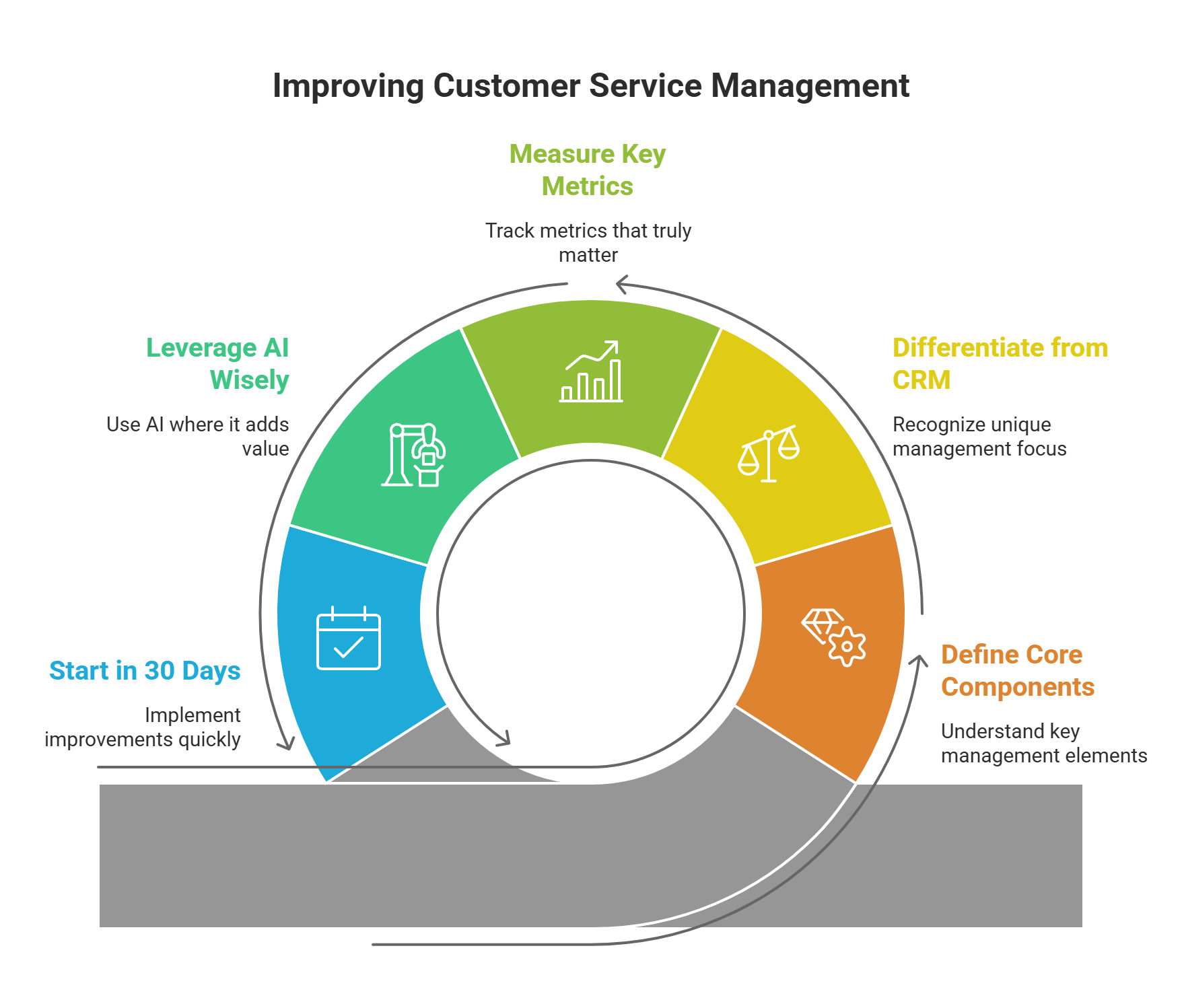
Customer service management is the framework that makes support consistent, measurable, and scalable across channels, teams, and workflows. It goes beyond basic ticketing by improving triage, routing, ownership, knowledge management, and SLA-driven execution so customers do not face fragmented or chaotic service. Effective customer service management depends on aligning people, process, technology, and governance to reduce customer effort and build trust over time. The post also highlights that success should be measured through balanced metrics like FCR, MTTR, SLA compliance, CSAT, and backlog health rather than volume alone. Finally, it explains that AI and Agentic AI can improve speed and consistency when used with verified data and controls, and that teams can start improving quickly by unifying intake, refreshing top knowledge articles, and tightening routing and escalation rules.
If "customer service management" sounds like corporate speak, you are not alone. Many teams add channels and a ticketing tool, yet customers still repeat themselves and escalations still feel chaotic. Customer service management is what turns support into a reliable operation: consistent across channels, measurable, and designed to improve over time.
1 - What is customer service management - really?
Customer service management (CSM) is the operating approach - plus the processes and technology behind it - that helps you deliver support consistently and efficiently. It covers how requests enter, how they are prioritized and routed, how work moves across teams, and how outcomes are measured. The goal is not just closing cases; it is reducing customer effort and building trust at scale.
2 - What problems does customer service management solve that "support tools" do not?
A basic support tool can log cases. Customer service management makes the end-to-end experience hold together when you have multiple channels, multiple products, and multiple teams.
- One service journey across email, chat, phone, and social - with shared context.
- Smarter triage and skills-based routing that reduces misroutes and rework.
- Clear ownership, escalation paths, and SLAs so handoffs do not break.
- Governed knowledge so answers stay consistent as you scale.
3 - What are the core components of customer service management?
Think of customer service management as four parts that must work together: people, process, technology, and governance. When one is missing, service depends on heroics.
People
- Defined roles (agents, specialists, leads) and clear collaboration with adjacent teams
- Coaching and quality routines so performance improves, not just stabilizes
Process
- A clear lifecycle: intake - triage - work - resolution - follow-up
- Prioritization, SLAs, and escalation rules that match customer commitments
Technology
- Omnichannel intake with a unified customer timeline
- Workflow automation + self-service and knowledge to reduce avoidable contacts
Governance
- Knowledge review standards and retirement so content stays accurate
- Controls for sensitive actions and data handling (approvals, logging)
4 - How is customer service management different from CRM and Customer Success?
These terms overlap, but they solve different problems:
- CRM: relationship data for sales and marketing (accounts, contacts, pipeline).
- Customer Success: adoption and outcomes - helping customers realize value and renew.
- Customer service management: service delivery - resolving issues and reducing effort.
Good teams connect them: CRM provides context, Customer Success provides signals, and customer service management ensures issues are handled efficientlyconsistently.
5 - What does "good" look like? Metrics that actually matter
If you only track volume, you will optimize for speed at the cost of quality. Strong customer service management uses a balanced set of measures:
- First Contact Resolution (FCR): issues solved without follow-ups.
- Mean Time to Resolve (MTTR): how quickly cases reach a real outcome.
- SLA compliance: whether service promises are consistently kept.
- Customer Satisfaction (CSAT): experience rating after resolution.
- Backlog health: aging, reopens, and cases stuck in waiting states.
6 - Where AI and Agentic AI help - and where they should not
AI can make customer service management faster and more consistent - but only when it is grounded in verified data and wrapped in controls.
Where AI helps today
- Summarizing long case histories so agents start with context
- Auto-classifying requests and suggesting routing based on intent
- Drafting replies in your brand voice while citing knowledge
What Agentic AI adds
Agentic AI goes further by executing multi-step workflows (for example: checking entitlement, initiating a refund request, scheduling service) while keeping humans in control through approvals and audit trails.
Where to be careful
- Do not let AI invent policy, pricing, or commitments.
- Avoid irreversible actions without explicit approval and strong logging.
7 - How do you start improving customer service management in 30 days?
You do not need a massive transformation. Start with three moves that reduce friction quickly:
- Unify intake: Route your top channels into one queue with consistent categories.
- Fix the top 20: Refresh knowledge for the most common questions and issues.
- Tighten routing and SLAs: Define priority rules and escalation paths for top workflows.
Then baseline a few metrics (FCR, MTTR, backlog aging). The fastest wins in customer service management come from making work repeatable and visible - so improvement becomes a habit, not a project.
Bottom line: customer service management is how you turn support from reactive firefighting into a dependable experience customers can trust - even as you scale channels, products, and volume.